- my first time viewing webcams it was like looking into a crystal bowl: http://www.christkindlesmarkt.de/english/index.php?navi=1&rid=9&artid=48 + http://www.earthcam.com/usa/newyork/timessquare/?cam=tsone_str
- webcams are like little eyes attached to the WWW, giving a sense of physicality to the ethereal nature of the net
- difference between telepresence + virtual reality (tp = remote action in a real space, vr= direct action in a virtual space)
- tele-presence surrounds us (examples: remote controls, remote surgery, video conferencing, hazardous environments, space exploration)
- tele-presence is fairly new, but the desire to overcome time + distance is old (one of the main driving forces of technological inventions)
- tele-portation starts with development of optical devices (tele-lenses, microscopes etc.)
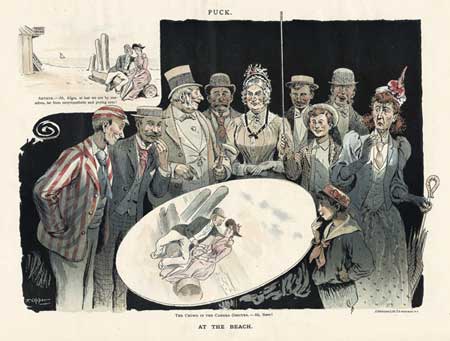
- Camera Lucida (mirror of life) is an especially good example and satisfied some of the same desires/fears that are today associated with webcams/security cams (David Hockney on artists using the camera)
- Invention of photography = transportation of images over distance but also with time delay. Telephone= no image but real time voice
- after the invention of the "Internet" tele-presence becomes available to wide public
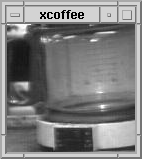
- First webcam = Trojan Room Coffee Pot
- CUSeeMe - first video conferencing software for Apple 1992
- SanFranFogCam - longest running webcam (it's the live-ness that makes images interesting not the images themselves)
- JenniCAM
- idea of privacy turned upside down, accused of exhibitionism, but formula is repeated many times
- 2009 - http://chatroulette.com/
The issue of voluntary surveillance
- Susan Sontag describing a street photographer:
“an armed version of the solitary walker reconnoitering, stalking, cruising the urban inferno, the voyeuristic stroller who discovers the city as a landscape of voluptuous extremes.”
Quote is inspired by Baudelaire's flaneur, can webcam surfer be considered the same?
- how has our understanding of privacy changed? Geroge Orwell's Big Brother is our standard metaphor for surveillance cam system.
- also related Laura Mulvey's "Visual Pleasures + Narrative Cinema" in which she describes the power of the male gaze in cinema.
- considering the power of cameras why does anyone voluntarily step infront of the camera voluntarily when it means giving up privacy?
- Camgirl Ana Voog felt lonely without her cam + sees internet as "collective unconscious where time + space no longer exist. Its being a part of a whole that gives new intimacy online." Also mentions that after a while she and Jenni forgot about the cameras in their rooms.
- How has the reaction to cam girls changed since their first appearance in 1996? The general spirit has changed from a cinema verite life infront of the camera to a more soldiery life FOR the camera. Caused by disappearance of public spaces? Did public place shift from the physical to the disembodied? Roaming the channels I see more webcam hosts with glow of monitor in their eyes waiting for updates. Webcams no longer seem to represent the eyes to the physical world but windows to stare into the virtual.
Artists working with surveillance + webcams or related material:
Jill Magid - Evidence Locker
Hasan M. Elahi - Tracking Transience TEDTalk
Amy Alexander - SVEN (passerby as rockstar)
Christian Moeller - Nosy (surveillance cam + LED display)
Steve Mann - WearCam
Wireless Intelligent Systems Laboratory @ Herbert F. Johnson Museum
Jason Bruges (designer) works with real-time digital data collection in a playful way see especially Visual Echo's
Adam Rifkin - Look (entirely shot with surveillance cameras)
Harun Farocki - Videograms of a Revolution
Wolfgang Staehle - Empire 24/7
Kyle McDonald - People Staring At Computers
Eva and Franco Mattes - No Fun
Ken Goldberg - Telegarden
Marie Sester - Access
Harun Farocki - Videograms of a Revolution
Wolfgang Staehle - Empire 24/7
Kyle McDonald - People Staring At Computers
Eva and Franco Mattes - No Fun
Ken Goldberg - Telegarden
Marie Sester - Access
Lecture/Performances:
Terence Koh - lecture/performance institutional critique
Alexandre Singh - overhead projectors + narratives
Ofri Cnaani
Guillaume Desanges - His Masters Voice
Eric Buenger - The Third Man
Bruce High Quality Foundation - Art History
Media and Performance
Nam June Paik: Electric Moon (1969)
- 1960's interest in performance because of its spontaneity, constitutional critique, artist-audience interaction. (Allan Kaprow Happenings)
- rise in conceptual and activist art made the lecture (teaching through art) a popular format
- Dan Graham - Performer/Audience/Mirror (1975)
Terence Koh - lecture/performance institutional critique
Alexandre Singh - overhead projectors + narratives
Ofri Cnaani
Guillaume Desanges - His Masters Voice
Eric Buenger - The Third Man
Bruce High Quality Foundation - Art History
Media and Performance
Nam June Paik: Electric Moon (1969)
Peter Campus: Three Transitions - from Persistence of Vision (1973)
Krzysztof Wodiczko - Tijuana
Contemporary Practitioners
Krzysztof Wodiczko - Tijuana
Contemporary Practitioners
Mia Makela - Kaamos Trilogy (2007)
Nadav Assor - Tunneling


)


